Messaging that keeps water systems operating when infrastructure doesn’t
Water and wastewater utilities operate vast, geographically dispersed infrastructure, pump stations, treatment plants, reservoirs, and remote sensors, connected over unreliable links. The messaging layer in these networks must remain predictable even when field conditions are not.
RelayQ ensures telemetry, control signals, and alarms remain consistent across power outages, connectivity loss, and misbehaving field devices.
Water infrastructure fails in the field
Pump stations lose power. Remote sensors go offline. Communication links drop without warning.
In traditional systems, these failures propagate: a malfunctioning sensor can corrupt downstream data, a stalled connection can delay alarms, and inconsistent state spreads across control systems.
RelayQ is designed to contain these failures.
Each device is isolated. Each connection is strictly bounded. The system continues operating across outages, connectivity gaps, and misbehaving field devices.
No cascading failure. No system-wide disruption.
Failure remains contained, by design.
The system behaves predictably even when the infrastructure does not.
Market challenge
Water operators face compounding pressures:
- Aging SCADA infrastructure being modernized with IP-based telemetry
- NIS2 and critical infrastructure directives expanding cybersecurity obligations
- Remote sites with constrained hardware, intermittent connectivity, and infrequent maintenance windows
- Increasing regulatory scrutiny on water quality data integrity
At the same time, field devices behave unpredictably, and traditional messaging layers do not isolate these failures.
Why this becomes expensive
Dependency-heavy brokers require ongoing patch management across dozens of remote sites that are difficult to access. When a CVE drops in OpenSSL or a transitive dependency, every pump station and treatment plant needs attention.
Weak message validation means corrupted sensor readings (flow rates, chlorine levels, pressure) can propagate into control decisions before anyone notices the data is wrong.
In many deployments, a single malfunctioning sensor or stalled connection can affect unrelated systems by introducing inconsistent state or delaying critical alarms.
How RelayQ addresses it
RelayQ enforces controlled behavior under real-world field conditions:
- Power outages do not result in data loss
- Connectivity loss does not corrupt system state
- Misbehaving devices cannot impact others
- Resource usage remains bounded across distributed sites
- The system remains predictable under failure conditions
- No slow or disconnected site can stall the system
Supporting characteristics:
- Zero mandatory dependencies (std-only core; TLS optional): minimal patch burden across remote sites
- Native Modbus RTU/TCP and DNP3: direct connection to PLCs and RTUs without external gateways
- WAL persistence: survives power loss at unattended pump stations
- Sparkplug-aware validation: rejects malformed topics and out-of-sequence node/device lifecycle messages at ingress
- ~4.6MB Full build (x86_64; ~3.6MB armv7): deploys on field RTUs and gateway hardware
Where RelayQ fits in the water architecture
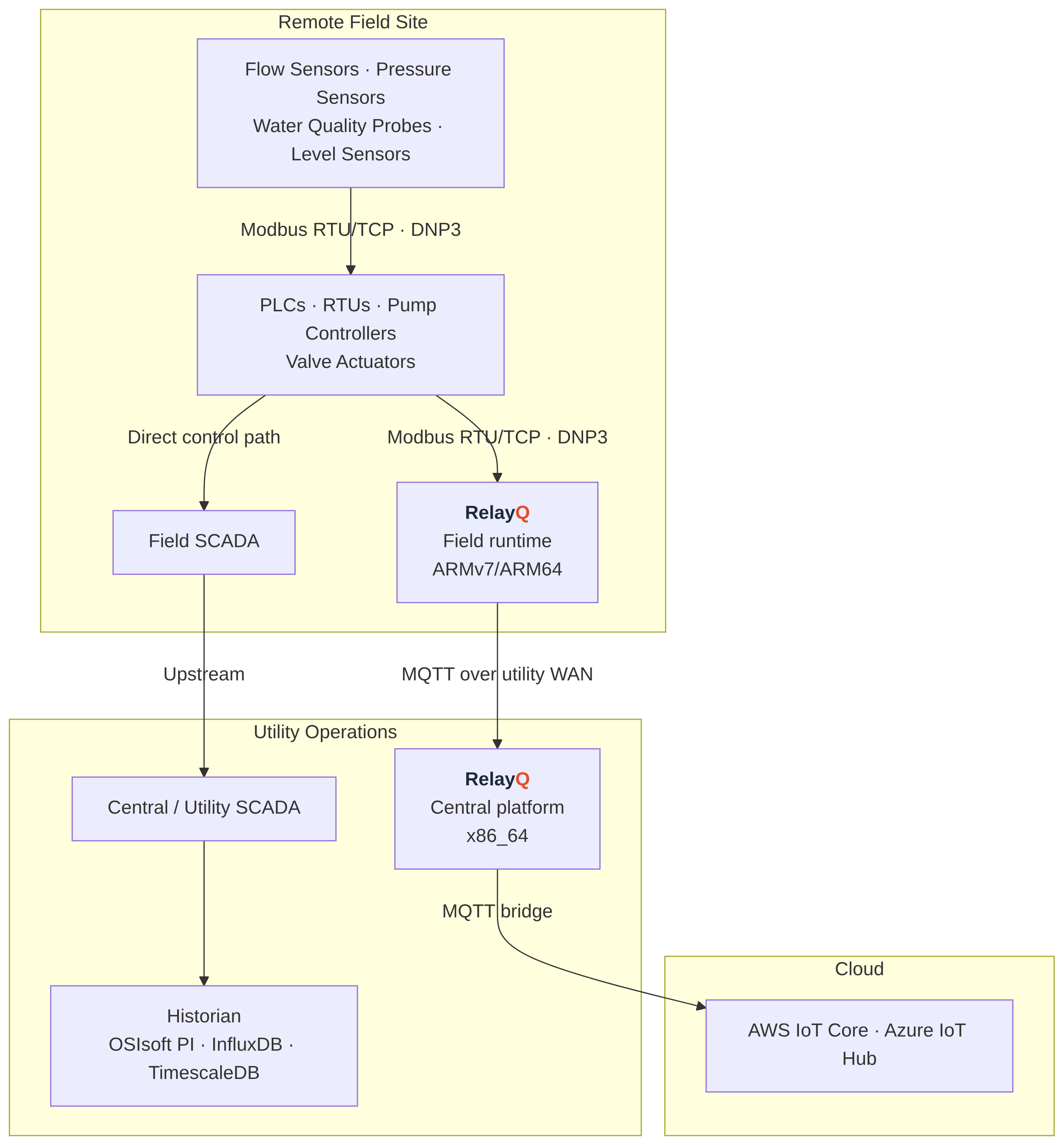
RelayQ operates as a single execution boundary, ensuring consistent system state across ingestion, buffering, and delivery, even across distributed, disconnected sites.
Field devices publish telemetry into RelayQ. SCADA hosts, historians, and control platforms subscribe to the topics they need. RelayQ does not replace your control platform, it protects it by containing failure and validating every message before delivery.
Integrates with:
- SCADA platforms: grid and utility SCADA for water distribution and treatment
- Field protocols: Modbus RTU/TCP (native), DNP3 (native)
- Historians: OSIsoft PI, InfluxDB, TimescaleDB
- Cloud platforms: AWS IoT Core (via MQTT bridge, validated); Azure IoT Hub via the bridge’s X.509 path only (unvalidated; no SAS-token support)
- Monitoring: Prometheus + Grafana, utility NOC dashboards
What data is exchanged, and why correctness matters
RelayQ validates and contains data at ingress, ensuring downstream systems operate on consistent and reliable state.
- Flow and pressure telemetry: drives hydraulic models and leak detection.
- Water quality metrics (chlorine residual, turbidity, pH): ensures regulatory compliance and public safety.
- Pump and valve status: informs control logic and maintenance scheduling.
- Alarm/event messages: trigger operator response for overflow, contamination, or equipment failure.
- Remote commands (pump start/stop, valve actuation): execute control actions safely across distance.
Corrupted or delayed water quality data can mask contamination events. Stale pump status can lead to overflow or dry-running. Data integrity at the messaging layer directly affects public health outcomes.
Deployment options
| Target | Architecture | Deployment |
|---|---|---|
| Pump station RTU | ARMv7, ARM64 | Static binary on embedded Linux |
| Treatment plant server | x86_64 | Docker container or systemd service |
| Reservoir/tank site | ARMv7 | ~3.6MB Full build (or ~1.0MB Lite) on solar-powered gateway |
| Central SCADA server | x86_64 | systemd service on Ubuntu/RHEL/Debian |
All deployments are a single static binary, no runtime, no interpreter, no shared libraries required.
What teams gain
- Systems that remain operational despite power loss, network issues, or device faults
- Faster isolation when sensors or stations misbehave
- Reduced risk of bad data affecting regulatory reporting
- Lower maintenance burden across geographically dispersed sites
- Simpler compliance posture for critical infrastructure audits
Systems that behave predictably under failure, not just under ideal conditions.
Ready to evaluate RelayQ?
Full-featured runtime. No credit card. Direct support.
Request Evaluation AccessNot ready to talk? Start with the evidence: conformance report · benchmarks