Messaging that keeps rail systems operating under failure conditions
Railway networks are among the most demanding environments for communication software: geographically distributed, safety-critical, subject to harsh conditions, and expected to operate for decades. The messaging layer connecting trains, trackside infrastructure, and control centers must remain predictable even when field conditions are not.
RelayQ ensures telemetry, signaling support, and control data remain consistent across power cycles, connectivity loss, and misbehaving trackside or onboard systems.
Railway systems fail in the field
Trackside equipment loses power. Communication links drop between train and control center. Onboard systems restart during operation.
In traditional messaging systems, these failures propagate: state becomes inconsistent, delayed or malformed messages reach control systems, and unrelated components are affected by a single fault.
RelayQ is designed to contain these failures.
Each device is isolated. Each connection is strictly bounded. The system continues operating across power cycles, connectivity gaps, and misbehaving components.
No cascading failure. No system-wide disruption.
Failure remains contained, by design.
The system behaves predictably even when the railway environment does not.
Market challenge
Rail operators and system integrators face a unique combination of pressures:
- Safety above all: messaging failures in signaling or train control can endanger passengers
- 20–30 year platform lifecycles: every software component becomes a long-term maintenance obligation
- Harsh field environments: power interruptions, vibration, temperature extremes, and intermittent connectivity are routine
- Regulatory compliance: EN 50128, EN 50129, IEC 62278 (RAMS), and emerging cybersecurity directives (NIS2, CER)
- Legacy integration: decades-old signaling and SCADA systems must coexist with modern IoT infrastructure
At the same time, trackside and onboard systems behave unpredictably, and traditional messaging layers do not isolate these failures.
Why traditional brokers break down in rail
- Dependency-heavy stacks create long-tail maintenance risk across 20+ year service contracts
- Large container images (200MB+) don’t fit on constrained trackside or onboard hardware
- No ingress validation means malformed messages can propagate to safety-adjacent systems
- Slow startup and weak persistence turn routine power cycles into service instability
- Complex SBOMs expand certification scope and sustainment cost year after year
More importantly, traditional brokers do not control how failures propagate across trackside, onboard, and control systems.
How RelayQ addresses railway requirements
RelayQ enforces controlled behavior under real-world railway conditions:
- Power cycles do not result in data loss
- Connectivity loss does not corrupt system state
- Misbehaving devices cannot impact others
- Resource usage remains bounded across distributed systems
- The system remains predictable under load and failure conditions
- No slow or failing component can stall the system
Supporting characteristics:
- Zero mandatory dependencies (std-only core; TLS optional): nothing to maintain, patch, or re-certify over 20+ years
- WAL persistence: messages survive power loss at trackside cabinets and onboard systems
- Deterministic behavior: thread-per-client model with no garbage collector, no async jitter
- ~4.6MB Full build (x86_64; ~3.6MB armv7): fits on constrained trackside controllers and onboard gateways
- Sparkplug-aware validation: rejects malformed topics and out-of-sequence node/device lifecycle messages at ingress
- Memory-safe (Rust): eliminates buffer overflows in a safety-adjacent communication path
Where RelayQ fits in the railway architecture
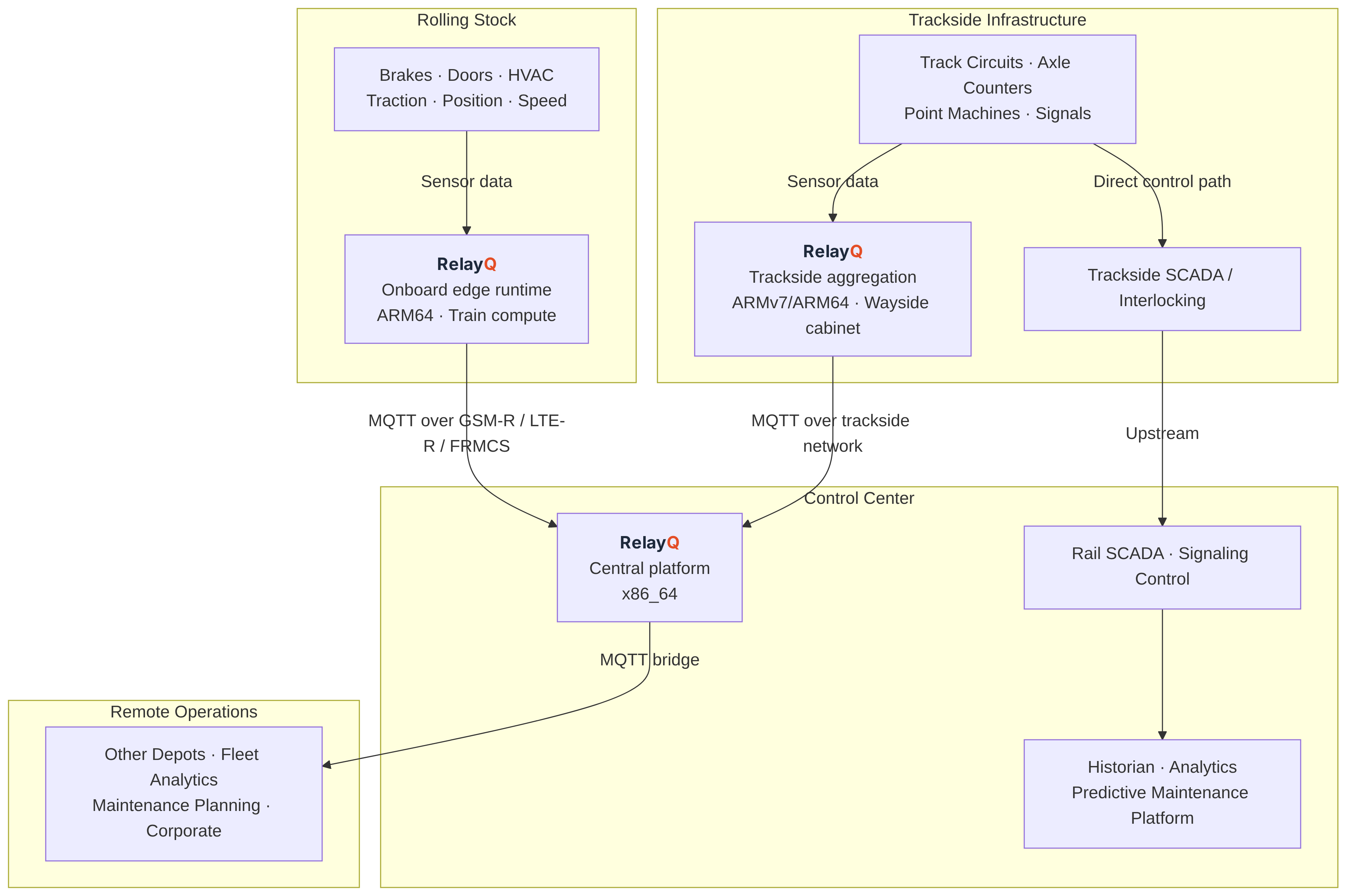
RelayQ runs alongside your existing rail SCADA and signaling infrastructure, not inside it. Your brownfield control path (trackside equipment → interlocking → Rail SCADA → Historian) remains untouched.
RelayQ reads from the same trackside sensors and onboard systems, providing a parallel telemetry path for fleet analytics, predictive maintenance, and cross-depot visibility.
RelayQ operates at three levels:
| Role | Where it runs | What it does |
|---|---|---|
| Onboard edge runtime | Train gateway (ARM64) | Aggregates rolling stock telemetry, buffers during connectivity gaps |
| Trackside aggregation | Wayside cabinet (ARMv7/ARM64) | Reads sensor data from track, points, signals |
| Central platform | On-prem server (x86_64) | Aggregates train and trackside telemetry, bridges to remote operations |
Integrates with:
- Signaling systems: interlocking controllers, axle counters, track circuits
- Train control: CBTC, ETCS data feeds (via protocol gateway)
- SCADA platforms: rail-specific SCADA for traction power, station systems
- Communication networks: GSM-R, LTE-R, FRMCS backhaul (as application-layer runtime)
- Historians and analytics: InfluxDB, TimescaleDB, predictive maintenance platforms
- Legacy systems: serial-to-MQTT gateways for older trackside equipment
Railway use cases
Signaling system telemetry
Track circuits, axle counters, and point machines report status to interlocking controllers. RelayQ validates message integrity at ingress, preventing malformed or stale data from reaching safety-critical decision logic. Default-deny ACLs ensure only authorized trackside devices can publish to signaling topics. A misbehaving device cannot affect unrelated signaling components.
Rolling stock health monitoring
Onboard sensors stream brake condition, door status, HVAC performance, and traction diagnostics to maintenance systems. RelayQ buffers messages to disk during tunnel transits and connectivity gaps and replays them when backhaul resumes; the bridge’s connection-liveness detection and delivery guarantees are still being hardened, so treat this as buffered best-effort delivery today, not a zero-data-loss guarantee.
Station infrastructure monitoring
Platform screen doors, escalators, CCTV systems, and environmental sensors publish status via MQTT. RelayQ’s rate limiting prevents a malfunctioning sensor from flooding the bus and delaying critical alarm messages from other station systems. No slow device can delay critical alerts.
Predictive maintenance data pipelines
Vibration, temperature, and wear data from wheels, bogies, and track components feeds machine learning models for predictive maintenance. RelayQ ensures data integrity at the messaging layer, corrupted inputs produce unreliable predictions. Message state remains consistent across restarts and power events.
Train-to-ground communication
Real-time position, speed, and operational status flows from train to control center. RelayQ’s deterministic latency and persistence ensure consistent delivery even across high-mobility, intermittent-connectivity environments. No disconnected train can stall the central ingestion pipeline.
Security mapped to railway threats
| Railway threat | How RelayQ mitigates |
|---|---|
| Compromised trackside device injecting false signals | Default-deny ACL, only authorized devices publish to signaling topics |
| Network-wide disruption from single compromised node | Per-client rate limiting + IP allowlist isolate misbehaving nodes |
| Supply-chain attack on broker dependencies | Zero mandatory dependencies, std-only core, no async runtime, no OpenSSL |
| Unauthorized access to train control topics | Topic-level ACL with separate namespaces for telemetry vs. control |
| Man-in-the-middle on GSM-R/LTE-R backhaul | TLS 1.3 + mTLS with certificate pinning |
| Denial of service exhausting trackside hardware | OOM guard + rate limiting prevent resource starvation |
Compliance and certification readiness
| Standard | RelayQ positioning |
|---|---|
| EN 50128 (Software for railway control) | Formal verification evidence, spec-traceable tests, deterministic behavior map to SIL objectives |
| EN 50129 (Safety-related electronic systems) | Fail-safe design principles: graceful degradation, no crash on malformed input |
| IEC 62278 / EN 50126 (RAMS) | Zero-dependency architecture supports reliability and maintainability over 20+ year lifecycle |
| IEC 62443 (Cybersecurity) | Zero-dependency SBOM, default-deny ACL, audit logging, brute-force protection |
| NIS2 / CER (EU cybersecurity) | Minimal attack surface, supply-chain transparency, incident-ready audit logs |
RelayQ is not yet formally certified to these standards. It is designed with certification readiness in mind, the engineering evidence (Kani proof harnesses, Loom concurrency models, fuzz testing, 4,902 spec-traceable tests) maps directly to certification objectives.
Proof points
- 6 million fuzz inputs, zero panics: codec hardened against malformed packets from any source
- 4,902 automated tests: traced to the protocol specifications, with per-requirement conformance reports
- Six 1-hour soak runs: sustained QoS 0/1/2 load with zero message loss
- WAL recovery after hard power cut: zero message loss across simulated power failures
- ~4.6MB Full build (x86_64; ~3.6MB armv7): fits alongside application code on constrained trackside controllers
Expected operational improvements
| Outcome | How |
|---|---|
| Reduced service interruptions | Rate limiting contains misbehaving devices; Sparkplug validation rejects malformed topics and out-of-sequence lifecycle messages at ingress |
| Lower 20-year sustainment cost | Zero mandatory dependencies = no forced upgrades, zero abandoned-library risk |
| Faster incident response | Built-in metrics and violation counters pinpoint misbehaving devices in real time |
| Shorter certification cycles | One-line SBOM, formal verification evidence, spec-traceable test coverage |
| Improved operational visibility | Prometheus metrics + $SYS topics provide fleet-wide runtime health monitoring |
| Seamless legacy integration | Runs alongside existing SCADA; serial-to-MQTT gateways bridge older equipment |
Legacy integration
RelayQ does not require replacing existing signaling or SCADA infrastructure. It deploys incrementally:
- Start at the edge: install on one trackside cabinet or onboard gateway
- Bridge legacy systems: use serial-to-MQTT or Modbus-to-MQTT gateways for older equipment
- Validate alongside existing infrastructure: run in parallel without disrupting operations
- Expand gradually: add more nodes as confidence builds
No big-bang migration. No vendor lock-in. RelayQ is a single binary you can deploy, test, and remove without side effects.
Deployment options
| Target | Architecture | Deployment |
|---|---|---|
| Trackside controller | ARMv7, ARM64 | Static binary on ruggedized Linux |
| On-board gateway | ARM64 | Embedded in train communication system |
| Operations centre | x86_64 | Docker container or systemd service |
| Wayside cabinet | ARMv7 | ~3.6MB Full build (or ~1.0MB Lite) on constrained hardware |
All deployments are a single static binary, no runtime, no interpreter, no shared libraries required.
Systems that behave predictably under failure, not just under ideal conditions.
Proof points are lab measurements on the stated hardware and build, see the benchmarks page for method. Results in your environment will differ.
Ready to evaluate RelayQ?
Full-featured runtime. No credit card. Direct support.
Request Evaluation AccessNot ready to talk? Start with the evidence: conformance report · benchmarks