Messaging that keeps clinical systems operating when devices don’t
Healthcare systems are among the most demanding environments for communication software: patient lives depend on timely, accurate data delivery. The messaging layer connecting bedside monitors, infusion pumps, imaging systems, and clinical platforms must remain predictable even when devices and networks are not.
RelayQ ensures patient telemetry, alarms, and device data remain consistent across failures, restarts, and misbehaving equipment.
Clinical systems fail unpredictably
Devices restart. Network segments drop. Sensors malfunction. Equipment is moved between wards without reconfiguration.
In traditional messaging systems, these failures propagate: a malfunctioning monitor can flood the alarm bus, a stalled connection can delay critical alerts, and inconsistent state spreads across clinical decision systems.
RelayQ is designed to contain these failures.
Each device is isolated. Each connection is strictly bounded. The system continues operating across device restarts, connectivity gaps, and misbehaving equipment.
No cascading failure. No system-wide disruption.
Failure remains contained, by design.
The system behaves predictably even when the clinical environment does not.
Market challenge
Medical device manufacturers and healthcare IT teams face unique pressures:
- Patient safety: delayed or corrupted telemetry can degrade clinical decision-making
- Regulatory burden: IEC 62304, ISO 14971, FDA 21 CFR Part 11, and HIPAA demand provable software quality and data protection
- Device fragmentation: hundreds of disconnected devices from multiple vendors in a single hospital
- Continuous uptime: ICU monitoring and critical care systems cannot tolerate communication failures
- Long validation cycles: every software component in a regulated device extends V&V effort
At the same time, medical devices behave unpredictably, and traditional messaging layers do not isolate these failures.
Why traditional brokers break down in healthcare
- 200+ dependencies enlarge hazard analysis and risk documentation under IEC 62304
- Frequent upstream updates force re-validation cycles that regulated release schedules can’t absorb
- No ingress validation means malformed device data can propagate to clinical decision systems
- Large container images don’t fit on bedside gateways or embedded medical hardware
- Complex SBOMs create ongoing maintenance burden that compounds across device fleet lifecycles
More importantly, traditional brokers do not control how failures propagate across devices, clinical systems, and alarm pathways.
How RelayQ addresses healthcare requirements
RelayQ enforces controlled behavior under real-world clinical conditions:
- Device restarts do not result in data loss
- Connectivity loss does not corrupt system state
- Misbehaving devices cannot impact other devices or data streams
- Resource usage remains bounded across hundreds of connected devices
- The system remains predictable under load and failure conditions
- No malfunctioning device can stall the system or delay critical patient alarms
Supporting characteristics:
- Zero mandatory dependencies (std-only core; TLS optional): minimal hazard analysis scope under IEC 62304
- Deterministic behavior: thread-per-client model with no garbage collector, no scheduling jitter
- WAL persistence: messages survive device restarts and power events without data loss
- Default-deny ACL: enforces data access boundaries aligned with HIPAA principles
- Audit logging: append-only evidence trail for regulatory compliance and incident investigation
- ~4.6MB Full build (x86_64; ~3.6MB armv7): fits on bedside gateways and embedded medical device hardware
- Formal verification: mathematical proofs provide evidence for regulated development programs
Where RelayQ fits in the healthcare architecture
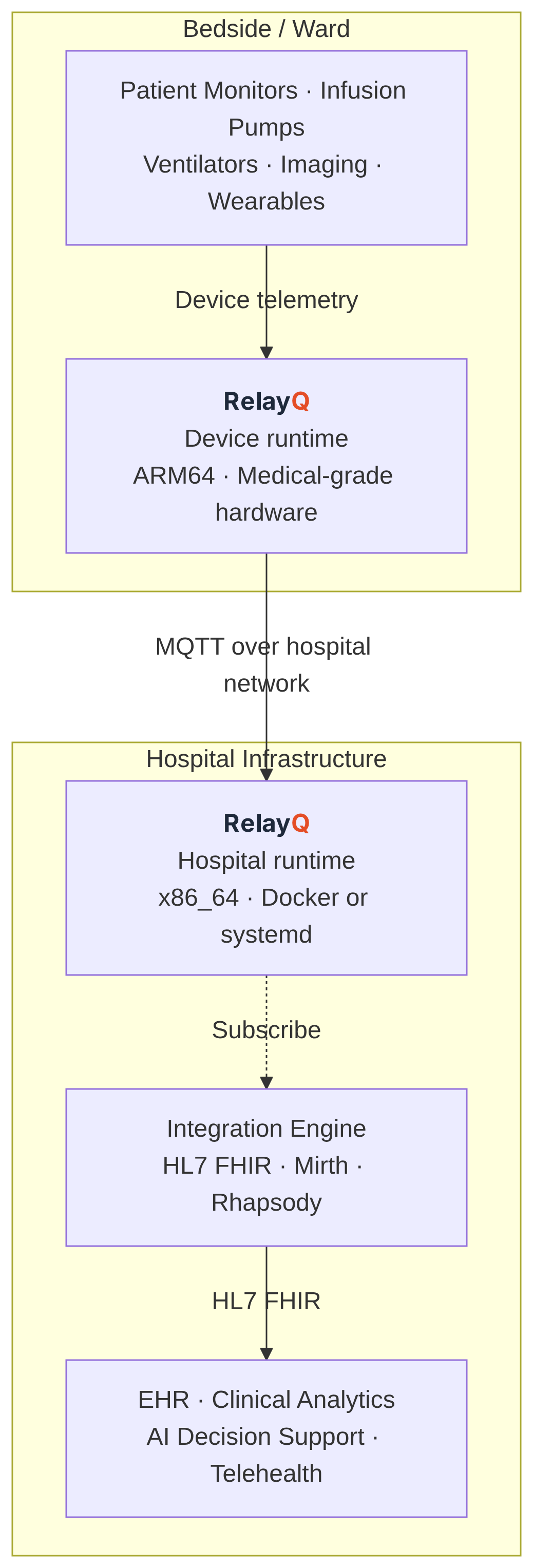
RelayQ operates as a single execution boundary, ensuring consistent system state across ingestion, buffering, and delivery, even across distributed clinical environments with unpredictable device behavior.
RelayQ operates at three levels:
| Role | Where it runs | What it does |
|---|---|---|
| Bedside/device gateway | Medical-grade ARM device | Aggregates patient monitor and device telemetry |
| Hospital infrastructure runtime | Edge server (x86_64) | Routes clinical data between devices, EHR, and analytics |
| Cloud ingestion runtime | Data center or cloud (x86_64) | Validates and delivers telemetry to remote monitoring platforms |
Integrates with:
- Clinical systems: EHR platforms (Epic, Cerner/Oracle Health), clinical data repositories
- Data standards: HL7 FHIR (via FHIR-to-MQTT bridge), HL7v2 (via integration engine)
- Medical devices: patient monitors, infusion pumps, ventilators, imaging systems (via device gateways)
- Monitoring: Prometheus + Grafana for broker health, clinical dashboards for patient data
- Cloud platforms: AWS HealthLake, Azure Health Data Services, Google Cloud Healthcare API
- Integration engines: Mirth Connect, Rhapsody, InterSystems HealthShare
Healthcare use cases
Real-time patient monitoring (ICU/telemetry)
Bedside monitors stream heart rate, SpO2, blood pressure, respiratory rate, and ECG waveforms to nursing stations and clinical decision systems. RelayQ’s deterministic latency ensures consistent delivery, no jitter from async runtimes or garbage collection pauses that could delay critical alarm propagation. A malfunctioning monitor cannot affect other patients’ data streams.
Connected medical device management
Infusion pumps, ventilators, and imaging systems publish status, dosage data, and fault alerts. RelayQ’s topic-level ACLs ensure each device class can only publish to its assigned namespace, a compromised pump cannot access patient records or other device streams. No single device failure can impact the broader clinical network.
Clinical alarm management
Alarm fatigue is a leading patient safety concern. RelayQ’s rate limiting prevents malfunctioning devices from flooding the alarm bus. Sparkplug validation rejects malformed topics and out-of-sequence device lifecycle messages at ingress. No noisy device can delay critical alerts from other equipment.
Remote patient monitoring (telehealth)
Wearable devices and home health monitors publish vital signs to cloud platforms. RelayQ buffers messages to disk during connectivity gaps (common in home environments) and replays them when connection resumes; the bridge’s connection-liveness detection and delivery guarantees are still being hardened, so treat this as buffered best-effort delivery today, not a zero-data-loss guarantee for longitudinal patient tracking.
Hospital asset tracking and environment monitoring
Temperature sensors in medication storage, air quality monitors in operating theatres, and RTLS tags on equipment publish status via MQTT. RelayQ provides the unified messaging backbone connecting these disparate systems. A misbehaving sensor cannot impact clinical data pathways.
Security mapped to healthcare threats
| Healthcare threat | How RelayQ mitigates |
|---|---|
| Unauthorized access to patient data | Default-deny ACL + mTLS, only authorized systems access patient topics |
| Compromised medical device injecting false data | Per-device topic restrictions; Sparkplug validation rejects malformed topics and out-of-sequence lifecycle messages at ingress |
| Ransomware targeting hospital infrastructure | Zero mandatory dependencies, minimal attack surface, no exploitable third-party code |
| Data breach exposing PHI | TLS 1.3 in transit + topic-level access control + audit logging |
| Device flooding causing alarm fatigue | Per-client rate limiting caps message volume |
| Insider threat / unauthorized device access | Audit logging records all access decisions for forensic review |
Compliance and regulatory readiness
| Standard | RelayQ positioning |
|---|---|
| IEC 62304 (Medical software lifecycle) | Zero-dependency architecture minimizes software items in hazard analysis; formal verification provides V&V evidence |
| ISO 14971 (Risk management) | Minimal risk surface in communication layer; deterministic behavior reduces residual risk |
| FDA 21 CFR Part 11 (Electronic records) | Audit logging, access control, data integrity by design |
| HIPAA (Privacy and security) | Default-deny ACL, TLS encryption, audit trail, minimum necessary access principle |
| IEC 60601 (Medical electrical equipment) | Complementary, RelayQ handles software communication; device safety remains with the device manufacturer |
| MDR / IVDR (EU medical device regulation) | Traceable engineering evidence supports technical documentation requirements |
RelayQ is not a medical device and is not FDA-cleared. It is designed as infrastructure software with regulatory readiness in mind, the engineering evidence (Kani proof harnesses, Loom concurrency models, fuzz testing, 4,902 spec-traceable tests) supports integration into regulated medical device systems.
Proof points
- 6 million fuzz inputs, zero panics: codec hardened against malformed packets from any device
- 4,902 automated tests: traced to the protocol specifications, with per-requirement conformance reports
- Six 1-hour soak runs: sustained load with zero message loss (simulates continuous monitoring)
- Deterministic latency: no GC pauses, no async jitter in critical alarm delivery paths
- WAL recovery after hard power cut: zero message loss across simulated clinical power events
- ~4.6MB Full build (x86_64; ~3.6MB armv7): validated on medical-grade ARM gateway hardware
Expected operational improvements
| Outcome | How |
|---|---|
| Improved patient safety | Deterministic alarm delivery + validated telemetry = fewer missed or false alarms |
| Reduced compliance burden | One-line SBOM, formal verification evidence, minimal IEC 62304 software items |
| Lower device integration cost | Standard MQTT protocol connects any device without vendor-specific middleware |
| Faster time to market | Minimal communication-layer risk analysis accelerates regulatory submissions |
| Reduced system downtime | WAL persistence + fast restart = continuous operation through power events |
| Better clinical visibility | Real-time device telemetry feeds dashboards, EHR, and decision support systems |
Device interoperability
Hospitals struggle with hundreds of disconnected devices from dozens of vendors. RelayQ provides a unified messaging layer:
- Vendor-neutral: any MQTT 3.1.1 client connects, regardless of manufacturer
- Protocol bridging: HL7v2-to-MQTT and FHIR-to-MQTT adapters connect legacy clinical systems
- Namespace isolation: each device class, department, or vendor gets its own topic namespace
- Incremental adoption: start with one ward or device class, expand without disrupting existing infrastructure
- No vendor lock-in: standard protocol, single binary, removable without side effects
Deployment options
| Target | Architecture | Deployment |
|---|---|---|
| Bedside gateway | ARM64, ARMv7 | Static binary on medical-grade ARM device |
| Hospital infrastructure | x86_64 | Docker container with TLS + ACL |
| Wearable/monitoring hub | ARMv7 | ~3.6MB Full build (or ~1.0MB Lite) embedded in OEM hardware |
| Clinical edge server | x86_64 | systemd service on Ubuntu/RHEL |
All deployments are a single static binary, no runtime, no interpreter, no shared libraries required.
Systems that behave predictably under failure, not just under ideal conditions.
Proof points are lab measurements on the stated hardware and build, see the benchmarks page for method. Results in your environment will differ.
Ready to evaluate RelayQ?
Full-featured runtime. No credit card. Direct support.
Request Evaluation AccessNot ready to talk? Start with the evidence: conformance report · benchmarks