Direction
All future development follows a single principle: expand capability without introducing new failure domains.
Pilot Available · v3.0.0-rc.2
The core runtime is available for pilot deployment today as a release candidate, with General Availability targeted for Q4 2026.
Non-intrusive by design, RelayQ never modifies the control system. It observes, structures, and delivers. If RelayQ stops, your plant continues.
Core Runtime
The foundation is a production-grade deterministic runtime with the following characteristics:
Edge Capabilities
All data processing is executed locally within the same runtime:
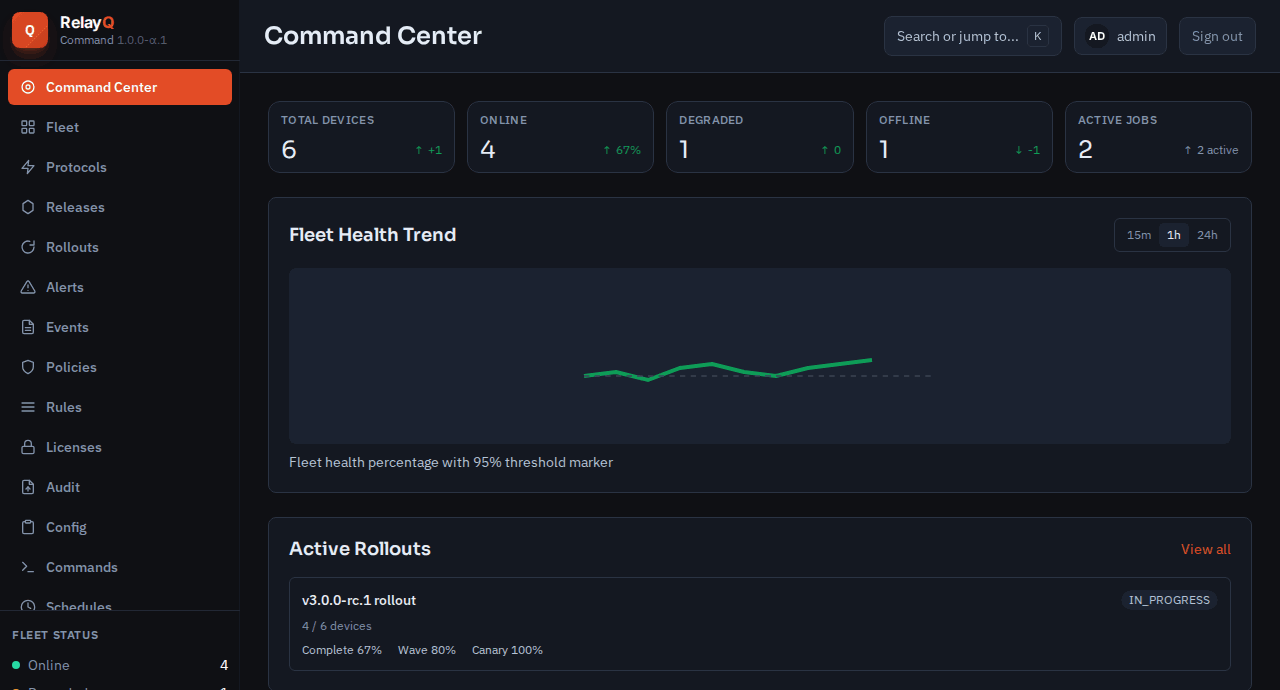
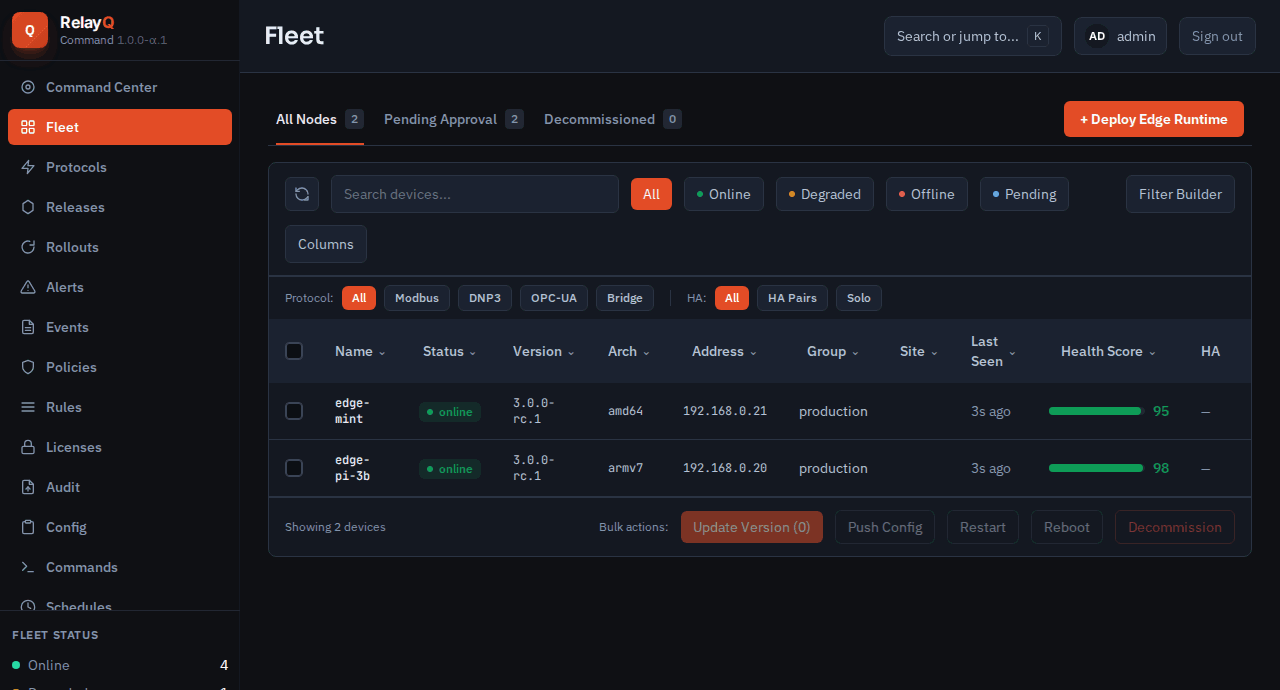
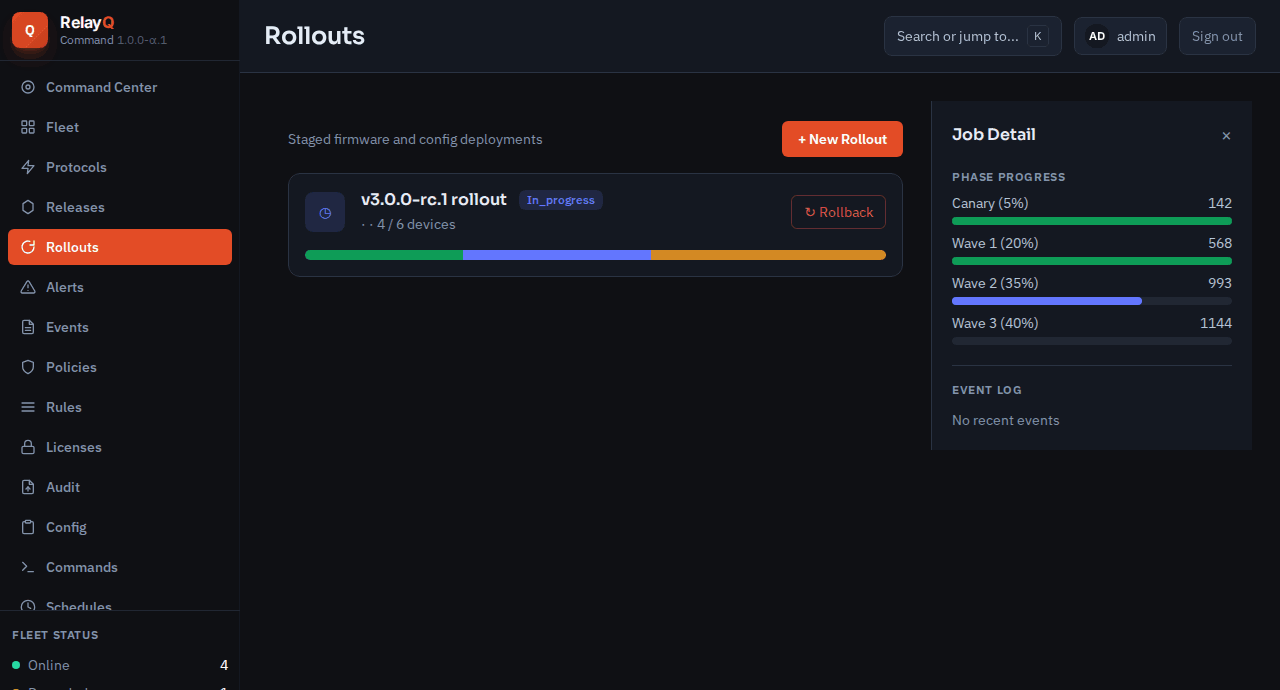
Command Center in action
Fleet enrolment, health monitoring, and staged rollouts from an on-premise control plane, in development, with evaluation opening at release-candidate stage. Edge devices operate independently without it.
General Availability
Production-grade release with full documentation, support SLAs, and commercial licensing.
- ○ Command Center from release candidate to supported release
- ○ Stable API and configuration format
- ○ Long-term support (LTS) commitment
- ○ Production deployment guides and runbooks
- ○ Commercial support and SLA options
Protocol Translation
RelayQ moves protocol handling into the runtime itself, eliminating external gateway layers.
Extended Capabilities
Clustering will not compromise the single-node guarantees by default. Any clustering model must preserve deterministic behavior, bounded resource usage, and predictable failure modes.
Single Runtime, Two Editions
RelayQ is a single binary with full capabilities in every deployment. There are no capability tiers or reduced versions. The edition is determined at runtime by the presence of a valid license file.
RelayQ's roadmap is not additive; it is disciplined.
- • Bounded behavior
- • Isolated failure
- • Zero mandatory dependencies
Evaluate the runtime under real-world failure conditions, not just ideal scenarios.
Request Evaluation Access